For 15 years, I diced onions the way I was taught in a restaurant kitchen, the way most professionals in the US do it. But even a well-established kitchen habit deserves a little questioning, especially when there is an easier, more precise alternative.
If you dread making that horizontal cut through an onion, parallel to the cutting board, you can skip it. The trick is to fan out your first cuts instead of cutting straight down. Then, when you slice across them, the onion falls apart into dice.
1. Trim, Halve, and Peel the Onion
Cut off the top of the onion, but leave the root end intact. That root will hold the layers together while you work.
- Stand the onion on its trimmed top.
- Cut it in half from root to top, through both poles.
- Peel each half, removing the papery skin.
- Clear the skins and scraps off your cutting board.
- Set the halves flat-side down, with the root ends facing away from you.
I often remove the first fleshy layer along with the dry skin. Even when that layer looks decent at first, it frequently has dry spots. Peel down to a good, usable layer rather than keeping one simply because it is not papery.
2. Fan Out the Cuts
This is the important change. Instead of keeping your knife vertical for every cut, vary its angle as you work across the rounded onion half. Think of the cuts as spokes in a fan: angled on one side, upright in the middle, and angled the other way on the opposite side.
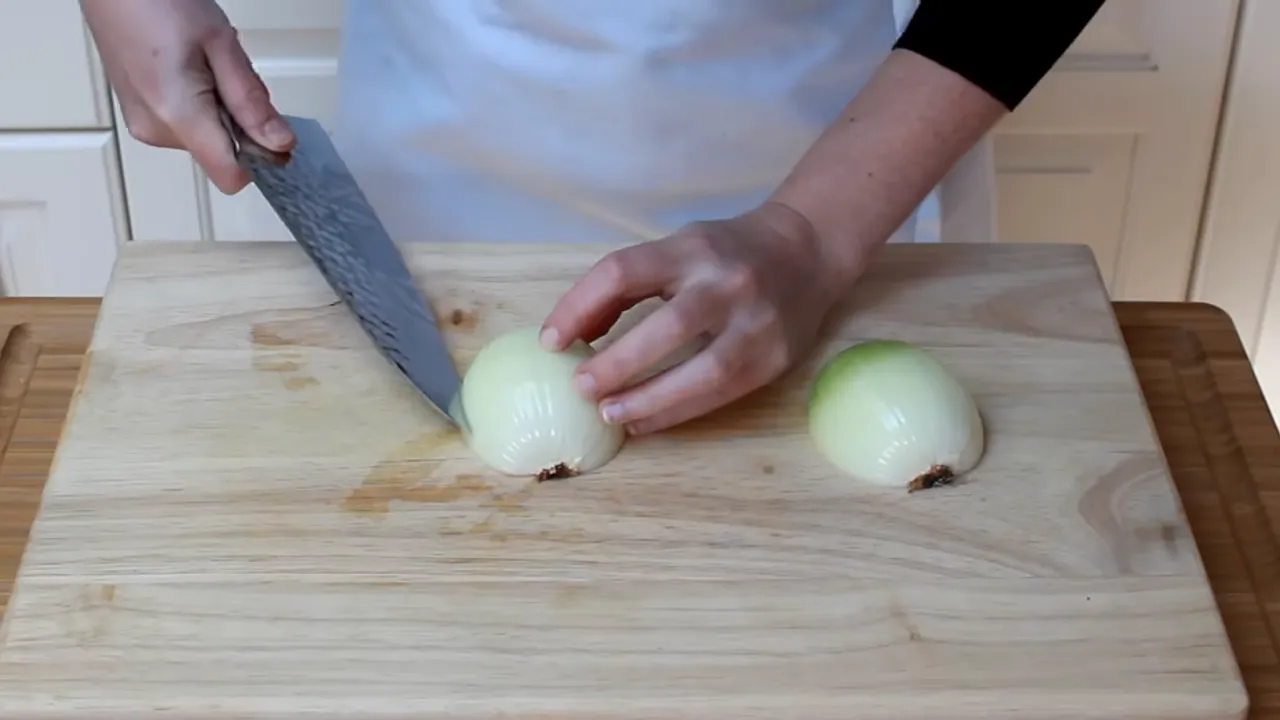
Each cut should reach the board, but stop short of cutting through the root end. Those are two different things. You want to cut through the onion’s depth while leaving its root end connected so the half stays together.
Use the tip portion of your knife for this step, rather than the back of the blade. It lets you make the cuts without slicing through the root.
Seen from the exposed end, the cuts should point toward the center rather than form a series of parallel vertical lines. That fan shape is what makes the horizontal cuts unnecessary.
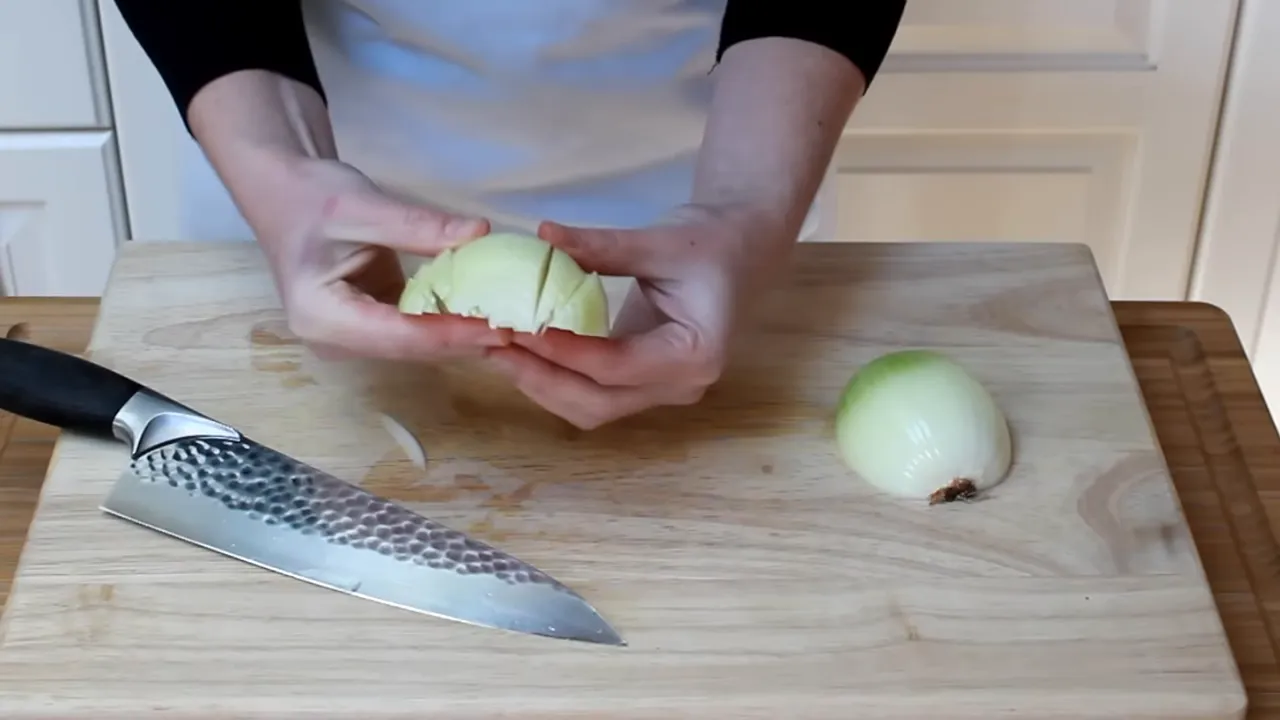
3. Slice Across to Make Dice
Turn the onion so you can slice across the cuts you just made. Position it under the back portion of your knife, near the handle, and cut perpendicular to the first set of slices, working toward the root.
Wait, what happened to the dreaded parallel cut? You do not need it. Because the first cuts fan through the onion’s layers, this final crosswise slicing releases the pieces into dice.
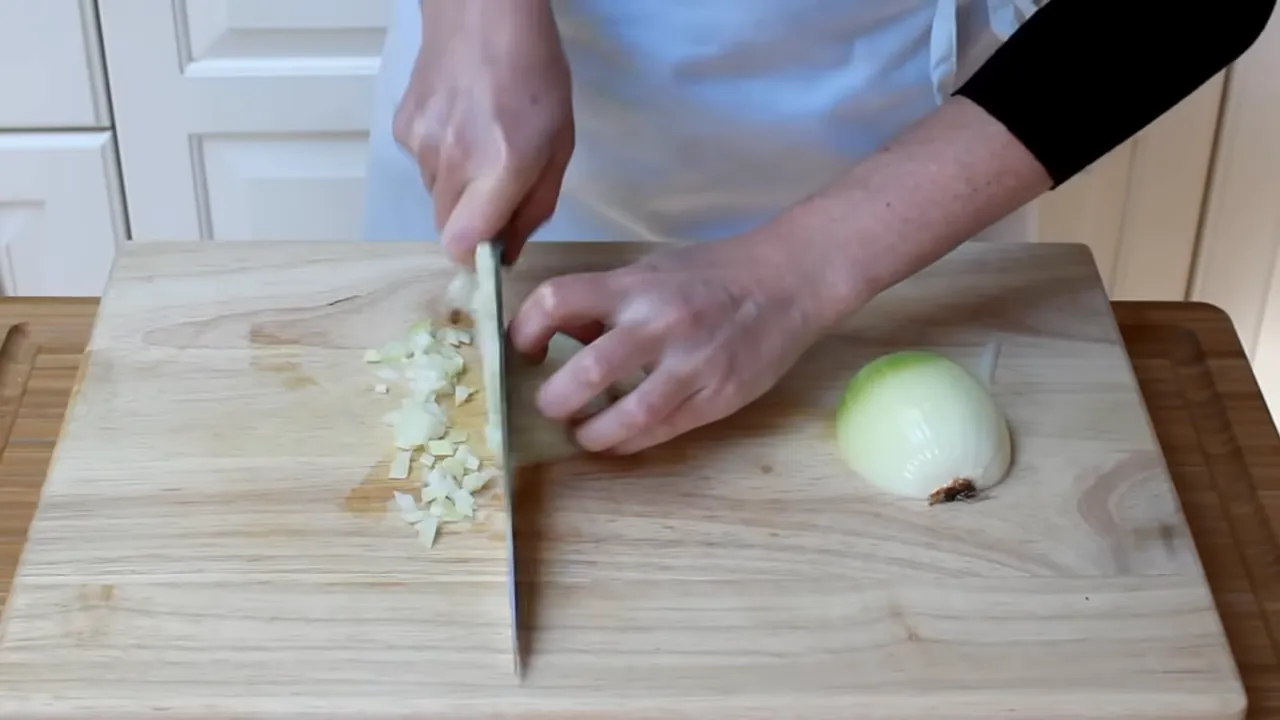
The distinction is simple: use the tip for the fan cuts, then the back of the knife for the crosswise slicing.
4. Use the Onion Around the Root
Once you reach the root, you will have a small piece left. If you want to use as much of the onion as possible, make a few incisions into the remaining flesh on both sides of the root, using the tip of your knife. Then slice across those sections to release the remaining dice.
Discard the root itself, and repeat with the second half.
How This Compares With the Traditional Method
The more common restaurant technique has three cutting stages:
- Make straight-down cuts through the onion half, leaving the root end connected.
- Make a few horizontal cuts parallel to the cutting board.
- Slice across with the back of the knife to produce dice.
Some cooks make the horizontal cuts before the vertical ones. Either order works, but changing the order does not remove the part that gives many people trouble: pushing the knife horizontally through the onion.
The fan-out method changes the first set of cuts and eliminates that horizontal stage altogether. The final crosswise slicing stays the same.
Why Don’t More Professionals Use the Fan-Out Method?
My guess is speed, but speed depends on who is holding the knife.
Professional cooks are very comfortable with a claw grip and can make straight-down cuts extremely quickly. I cannot fan out an onion as quickly as I can make those vertical cuts. And when you dice 50 onions a day, you get very good at the awkward horizontal cut, too.
For home cooks, the calculation is different. After helping hundreds of home cooks chop onions and teaching three different approaches, I have found the fan-out technique much faster and easier for them.
A method does not have to be the fastest choice in a restaurant kitchen to be the best choice in yours. If the parallel cut has been the frustrating part of dicing onions, try changing the angle of your first cuts instead.
If you are in the Boston area and would like to practice these techniques with me, I teach in-person knife skills classes at Helen’s Kitchen.
|


